Sooner or later, something fundamental in your business world will
change.
I'm often credited with the motto, "Only the paranoid survive." I have no
idea when I first said this, but the fact remains that, when it comes to
business, I believe in the value of paranoia. Business success contains the
seeds of its own destruction. The more successful you are, the more people want
a chunk of your business and then another chunk and then another until there is
nothing left. I believe that the prime responsibility of a manager is to guard
constantly against other people's attacks and to inculcate this guardian
attitude in the people under his or her management.
The things I tend to be paranoid about vary. I worry about products getting
screwed up, and I worry about products getting introduced prematurely. I worry
about factories not performing well, and I worry about having too many
factories. I worry about hiring the right people, and I worry about morale
slacking off.
And, of course, I worry about
competitors. I worry about other people figuring out how to do what we do better
or cheaper, and displacing us with our customers.
But these worries pale in comparison to how I feel about what I call
strategic inflection points.
I'll describe what a strategic inflection point is a bit later in this book.
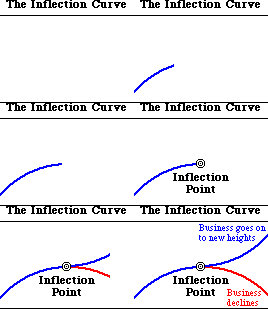
For now, let me just say that a strategic inflection point is a time in the life
of a business when its fundamentals are about to change. That change can mean an
opportunity to rise to new heights. But it may just as likely signal the
beginning of the end.
Strategic inflection points can be caused by technological change but they
are more than technological change. They can be caused by competitors but they
are more than just competition. They are full-scale changes in the way business
is conducted, so that simply adopting new technology or fighting the competition
as you used to may be insufficient. They build up force so insidiously that you
may have a hard time even putting a finger on what has changed, yet you know
that something has. Let's not mince words: A strategic inflection point can be
deadly when unattended to. Companies that begin a decline as a result of its
changes rarely recover their previous greatness.
But strategic inflection points do not always lead to disaster. When the way
business is being conducted changes, it creates opportunities for players who
are adept at operating in the new way. This can apply to newcomers or to
incumbents, for whom a strategic inflection point may mean an opportunity for a
new period of growth.
You can be the subject of a strategic inflection point but you can also be
the cause of one. Intel, where I work, has been both. In the mid-eighties, the
Japanese memory producers brought upon us an inflection point so overwhelming
that it forced us out of memory chips and into the relatively new field of
microprocessors. The microprocessor business that we have dedicated ourselves to
has since gone on to cause the mother of all inflection points for other
companies, bringing very difficult times to the classical mainframe computer
industry. Having both been affected by strategic inflection points and having
caused them, I can safely say that the former is tougher. I've grown up in a
technological industry. Most of my experiences are rooted there. I think in
terms of technological concepts and metaphors, and a lot of my examples in this
book come from what I know. But strategic inflection points, while often brought
about by the workings of technology, are not restricted to technological
industries.
The fact that an automated teller machine could be built has changed banking.
If interconnected inexpensive computers can be used in medical diagnosis and
consulting, it may change medical care. The possibility that all entertainment
content can be created, stored, transmitted and displayed in digital form may
change the entire media industry. In short, strategic inflection points are
about fundamental change in any business, technological or not.
We live in an age in which the pace of technological change is pulsating ever
faster, causing waves that spread outward toward all industries. This increased
rate of change will have an impact on you, no matter what you do for a living.
It will bring new competition from new ways of doing things, from corners that
you don't expect.
It doesn't matter where you live. Long distances used to be a moat that both
insulated and isolated people from workers on the other side of the world. But
every day, technology narrows that moat inch by inch. Every person in the world
is on the verge of becoming both a coworker and a competitor to every one of us,
much the same as our colleagues down the hall of the same office building are.
Technological change is going to reach out and sooner or later change something
fundamental in your business world.
Are such developments a constructive or a destructive force? In my view, they
are both. And they are inevitable. In technology, whatever can be done will be
done. We can't stop these changes. We can't hide from them. Instead, we must
focus on getting ready for them. The lessons of dealing with strategic
inflection points are similar whether you're dealing with a company or your own
career. If you run a business, you must recognize that no amount of formal
planning can anticipate such changes. Does that mean you shouldn't plan? Not at
all. You need to plan the way a fire department plans: It cannot anticipate
where the next fire will be, so it has to shape an energetic and efficient team
that is capable of responding to the unanticipated as well as to any ordinary
event. Understanding the nature of strategic inflection points and what to do
about them will help you safeguard your company's well-being. It is your
responsibility to guide your company out of harm's way and to place it in a
position where it can prosper in the new order. Nobody else can do this but you.
If you are an employee, sooner or later you will be affected by a strategic
inflection point. Who knows what your job will look like after cataclysmic
change sweeps through your industry and engulfs the company you work for? Who
knows if your job will even exist and, frankly, who will care besides you?
Until very recently, if you went to work at an established company, you could
assume that your job would last the rest of your working life. But when
companies no longer have lifelong careers themselves, how can they provide one
for their employees?
As these companies struggle to adapt, the methods of doing business that
worked very well for them for decades are becoming history. Companies that have
had generations of employees growing up under a no-layoff policy are now dumping
10,000 people onto the street at a crack. The sad news is, nobody owes you a
career. Your career is literally your business. You own it as a sole proprietor.
You have one employee: yourself. You are in competition with millions of similar
businesses: millions of other employees all over the world. You need to accept
ownership of your career, your skills and the timing of your moves. It is your
responsibility to protect this personal business of yours from harm and to
position it to benefit from the changes in the environment. Nobody else can do
that for you.
Having been a manager at Intel for many years, I've made myself a student of
strategic inflection points. Thinking about them has helped our business survive
in an increasingly competitive environment. I'm an engineer and a manager, but I
have always had an urge to teach, to share with others what I've figured out for
myself. It is that same urge that makes me want to share the lessons I've
learned.
This book is not a memoir. I am involved in managing a business and deal
daily with customers and partners, and speculate constantly about the intentions
of competitors. In writing this book, I sometimes draw on observations I have
made through such interactions. But these encounters didn't take place with the
notion that they would make it into any public arena. They were business
discussions that served a purpose for both Intel and others' businesses, and I
have to respect that. So please forgive me if some of these stories are
camouflaged in generic descriptions and anonymity. It can't be helped.
What this book is about is the impact of changing rules. It's about finding
your way through uncharted territories. Through examples and reflections on my
and others' experiences, I hope to raise your awareness of what it's like to go
through cataclysmic changes and to provide a framework in which to deal with
them.
Copyright © 1996 by Andrew S. Grove. All rights reserved.